April 15, 2026 · Shopify API
Modern Interior Design Definition: What It Is and How to Get the Look

Modern interior design is a style of planning and furnishing interiors that grew out of the modern art movement and the Machine Age of the early 20th century. Its defining ideas are clean lines, uncluttered spaces, minimal ornamentation, and furniture that earns its place by being useful. If you have ever walked into a room with a low platform sofa, a bare wood floor, and a wall of glass and felt an immediate sense of calm, you have felt modern design at work. It is a distinct style, and interior designers use it to create spaces that are both functional spaces and visually calm.
This guide gives you the modern interior design definition in plain terms, traces where the style came from, separates modern from contemporary (the most common mix-up), and walks through the materials, colors, lighting, and furniture that make a room read as modern. It finishes with a room-by-room checklist and a note on why this look is so popular when homes are photographed and staged for sale.
A Short History of Modern Interior Design
Modern design took shape in the early 20th century, when architects and designers turned away from the heavy ornament of the Victorian era. The architect Louis Sullivan summed up the new attitude in 1896 with the phrase "form ever follows function," and it became the rallying cry for everything that followed.
The Bauhaus and the Machine Age
The Bauhaus, a German school of art and design founded by Walter Gropius in Weimar in 1919, did more than any other institution to define the style. It combined fine art with craftsmanship and taught designers to create objects that could be made by industrial methods. Around the same time, the architect Le Corbusier described a house as "a machine for living in," a line that captures the Machine Age belief that good design should be efficient, rational, and honest about how it is made. The Bauhaus closed in 1933 under pressure from the Nazi government, and many of its teachers emigrated, carrying their ideas to the United States.
One of those figures, Ludwig Mies van der Rohe, gave the movement its best-known slogan, "less is more." With designer Lilly Reich he created the Barcelona Chair for the German Pavilion at the 1929 Barcelona International Exposition: a steel frame, leather cushions, and nothing extra. His Farnsworth House, completed in 1951, pushed the same thinking to its limit with glass walls, a flat roof, and almost no interior partitions.
Mid-Century Modern Design
After World War II, modern ideas moved from museums and architects' studios into ordinary homes. The period from roughly the mid-1940s through the 1960s, the middle of the twentieth century, is usually called mid-century modern design. New materials such as molded plywood and fiberglass made furniture lighter and more affordable, and the Eames Lounge Chair and Ottoman, introduced by Charles and Ray Eames in 1956, became a lasting symbol of the era. Scandinavian design and Scandinavian architecture added a softer note, pairing the same clean forms with warm wood and a focus on everyday comfort. New houses also adopted the open floor plan, with fewer walls and living, dining, and kitchen areas flowing together.
The Defining Characteristics of This Interior Design Style
Modern is one interior design style among many. If you are trying to identify your own interior design style, these are the markers to look for in this design style. If a room has most of them, it will read as modern. Interior designers return to modern style again and again because it is flexible: the same principles work in a small apartment, a family house, or a hotel lobby, and they combine well with different styles.
Clean Lines and Geometric Shapes
Straight lines, right angles, and simple geometric shapes dominate modern rooms. Sofas have crisp edges, tables are rectangular or perfectly round, and cabinetry is flat-fronted with little or no trim. The aim is visual harmony rather than decoration, so unnecessary elements and unnecessary ornamentation are removed, and nothing looks overly ornate.
Open Layouts and Uncluttered Spaces
An open floor plan lets one area flow into the next, and open plan layouts help interior designers create spaces that adapt as daily life changes. Furniture is arranged to keep clear paths through the room. Modern design treats empty space as a feature. Surfaces stay clear, storage is built in or hidden, and each object on display is chosen deliberately.
Natural Light and Large Windows
Modern homes bring in as much daylight as possible. Large windows, glass doors, and floor-to-ceiling windows connect the interior to the outdoors and make rooms feel larger. Where the structure allows, floor to ceiling windows bring in the most natural light of all, and the light itself becomes part of the decor. Window treatments are kept simple, usually plain roller shades, sheer panels, or none at all, so the glass does the work.

Neutral Colors With One Bold Accent
The base of a modern room is a palette of neutral colors: white, gray, black, beige, and soft earth tones. Color arrives in small, controlled doses, such as a single saturated armchair, a piece of art, or a rug. Keeping the background quiet is what makes the accent look intentional.
Natural and Industrial Materials
Modern design pairs natural materials, including wood, leather, stone, and wool, with industrial materials such as steel, glass, chrome, and concrete. The contrast is part of the look. A walnut dining table beside a steel-framed chair shows off the character of both. Surfaces are usually smooth and left unadorned, so the material itself provides the texture. Natural textures such as linen, wool, and raw wood stop the natural materials from feeling cold.
Modern Furniture, Art and Decor
Good furniture design in this style is known for sleek lines and crisp lines, a legacy of furniture designers who valued function over the decorative arts of earlier eras. Modern art, such as abstract paintings, sculpture, and graphic prints, is a natural partner because modern art and modern design grew out of the same movement. For modern decor, choose a few decorative objects in neutral tones with strong shapes rather than many small ones, and leave open spaces around each so it can be seen. The result is a modern space that feels calm and curated rather than empty.
Statement Furniture and Intentional Lighting
Modern rooms use fewer pieces of furniture, and each one counts. Functional furniture with a sculptural shape, like an arc floor lamp or a molded lounge chair, becomes the focal point. Lighting design follows the same logic: layered ambient, task, and accent lighting, often with a single sculptural pendant that doubles as decor.
Modern vs. Contemporary Design: What Is the Difference?
People often use the terms interchangeably, but they mean different things. Modern design refers to a specific historical movement, centered on the early to mid-20th century. Contemporary design describes whatever is current, so it is constantly evolving and borrows freely from many styles, including modern.
| Feature | Modern | Contemporary |
|---|---|---|
| Time frame | Roughly the 1920s to the 1960s | The present day, always changing |
| Lines | Straight, geometric, and crisp | Often softer, with curves and mixed shapes |
| Colors | Neutral base with controlled accents | Neutral base, but trend colors change often |
| Materials | Wood, leather, steel, glass, concrete | Any, including new and recycled materials |
| Approach | Follows established design principles | Follows the current moment |
Contemporary Style and Contemporary Interior Design Today
Contemporary style is harder to pin down because it keeps moving, which is the heart of the modern vs contemporary question. Today, contemporary interior design tends to mix soft curves, textured fabrics, and mixed metals with the simple shapes inherited from modern design, and it reflects new technologies such as smart lighting and energy-efficient glass. If you are decorating, the practical takeaway is simple. Choose modern style when you want a particular, consistent look with roots in the Bauhaus and the mid twentieth century. Choose contemporary design when you want the freedom to mix current trends. Many homes blend modern and contemporary elements, and mixing the two in one room is perfectly fine.

How Art Deco and Mid-Century Modern Fit In
Art Deco flourished in the same decades as early modernism, but it went in the opposite direction on decoration. Art Deco embraced rich materials, bold patterns, and glamorous ornament, while modern design stripped ornament away. Mid-century modern design is a branch of the modern movement rather than a separate idea: it keeps the clean lines and honest materials but adds organic curves and warmer wood tones.
Modern Interior Design Room by Room
Modern Living Room
A modern living room starts with a low-profile sofa in a solid neutral, a simple coffee table, and one statement piece such as a lounge chair or an arc lamp. Keep the living room floor plan open, hang a single large piece of art rather than a gallery wall, and let the windows frame the view. Because this uncluttered living room look is so easy to read in a photograph, it is also one of the styles most often chosen when a vacant living room is virtually staged.
Modern Dining Room
The modern dining room often sits open to the living room and kitchen. In the dining room, choose a table with a clean silhouette, whether a rectangle in solid wood or a round pedestal in stone or lacquer. Chairs can be molded, upholstered, or leather-slung, but they should share a visual language. A single pendant over the table gives the room its focal point.
Modern Kitchen
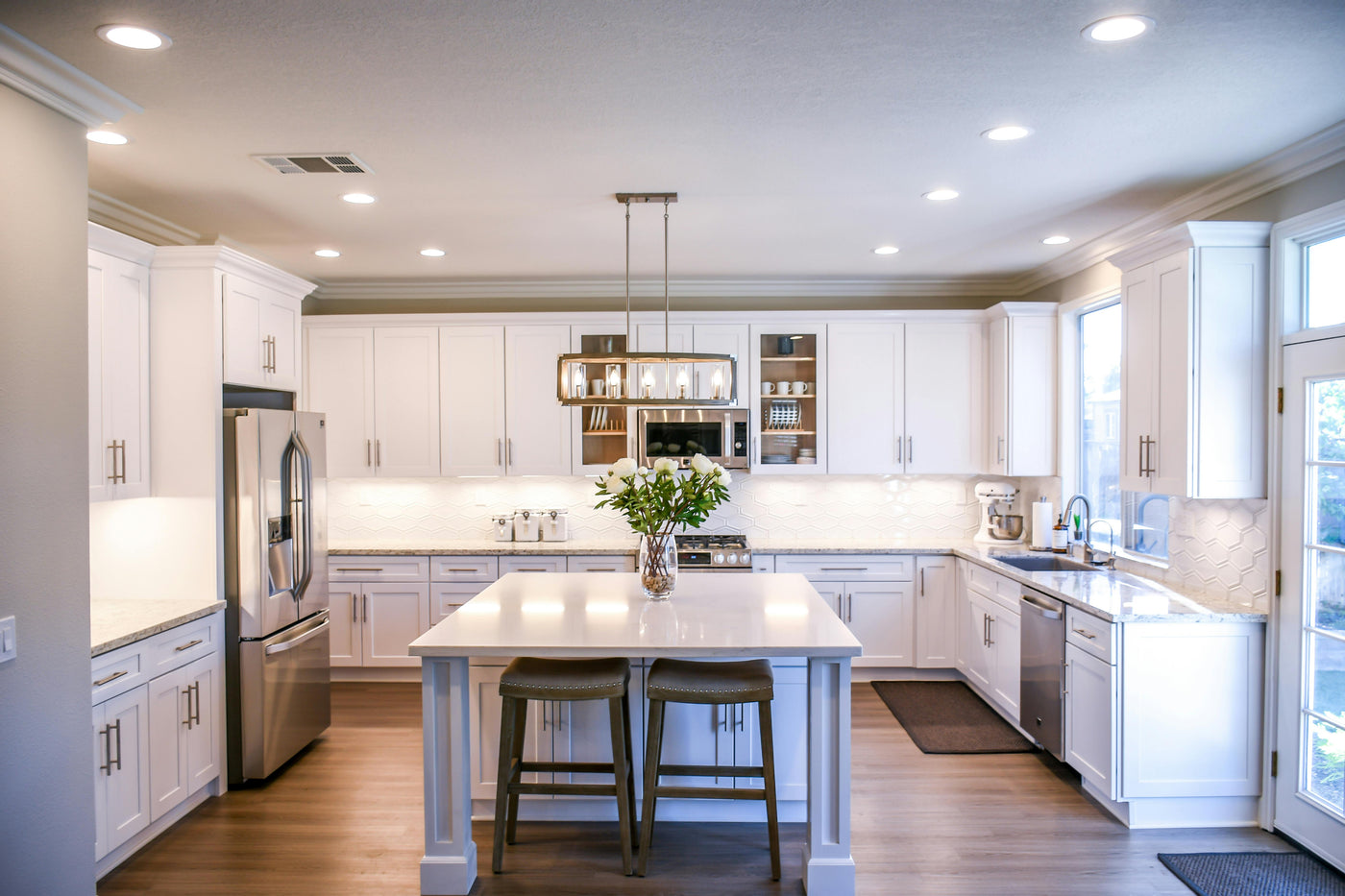
Flat-panel cabinets, handleless or minimal hardware, integrated appliances, and uninterrupted countertops define the modern kitchen. Concealed storage keeps surfaces clear, and a waterfall island or a simple steel-and-wood bar stool setup adds a contemporary detail without breaking the style.
Modern Bedroom
Modern homes treat the bedroom as a retreat. Bedrooms follow the same rule of restraint: a platform bed with a simple headboard, matching low nightstands, plain bedding in one or two tones, and a single piece of art. Built-in wardrobes keep floor space open.

Modern Style in Commercial Spaces
The same principles work in offices, hotels, and showrooms. Commercial spaces benefit from open layouts, durable materials, and strong lighting design, and the restrained palette keeps attention on people, products, and architecture.
How to Get the Modern Look: 6 Practical Steps
- Declutter first. Remove anything that does not serve a purpose or bring real pleasure. Uncluttered spaces are the foundation of the style.
- Set a neutral base. Paint walls white, warm gray, or greige and keep large surfaces, like floors and sofas, in related tones.
- Choose fewer, better furniture pieces. Look for clean lines, visible craftsmanship, and honest materials. One or two iconic pieces, such as a Barcelona-style chair or an Eames-style lounger, can carry the whole room.
- Add natural materials. Introduce wood, leather, wool, or stone to warm up the steel and glass.
- Maximize natural light. Clear windowsills, use light window treatments, and add mirrors to bounce daylight deeper into the room.
- Add one bold accent and stop. A single color or artwork gives the room personal expression without breaking the calm.
If you are still deciding on a look, a virtual home design preview lets you see a modern layout in your own room before you buy any furniture.
Modern Design and Selling a Home
Because modern homes are bright, simple, and easy to understand at a glance, they photograph well, which matters when most buyers start their search online. At Bella Virtual Staging, our designers can furnish an empty room in a modern style, from a modern living room to a modern bedroom, so buyers can picture how the space works, without renting a single piece of furniture. If you are preparing a listing, see our guide to staging a living room, or explore our virtual staging and 3D rendering services for homes and new builds.
Frequently Asked Questions About Modern Interior Design
What is the definition of modern design?
Modern design is a design movement that began in the early 20th century and emphasizes function, simplicity, clean lines, and honest use of materials. In interiors, it means uncluttered rooms, minimal ornamentation, neutral colors, and furniture that is useful as well as beautiful.
What is modern vs. contemporary design?
Modern design refers to a historical movement, roughly the 1920s through the 1960s. Contemporary design describes the styles of the present day, so it changes over time and often mixes elements from several periods.
What are some examples of modern design?
Classic examples include the Barcelona Chair (1929) by Ludwig Mies van der Rohe and Lilly Reich, the Eames Lounge Chair and Ottoman (1956), and Mies van der Rohe's glass-walled Farnsworth House (1951). In a home, a platform bed, a low sofa with straight lines, and a room with large windows and a neutral palette are everyday examples.
What are the four types of interior design?
Interior design is commonly grouped into residential, commercial, hospitality, and specialty design, with specialty covering areas such as healthcare, retail, and education. Modern style can be applied to every one of them.
Is modern interior design still popular?
Yes. Its focus on light, space, and simplicity continues to influence new homes, and many contemporary interiors borrow its clean lines and natural materials.