August 26, 2026 · Bella Virtual Design Team
Manhattan Condo Virtual Staging: Murray Hill Case Study
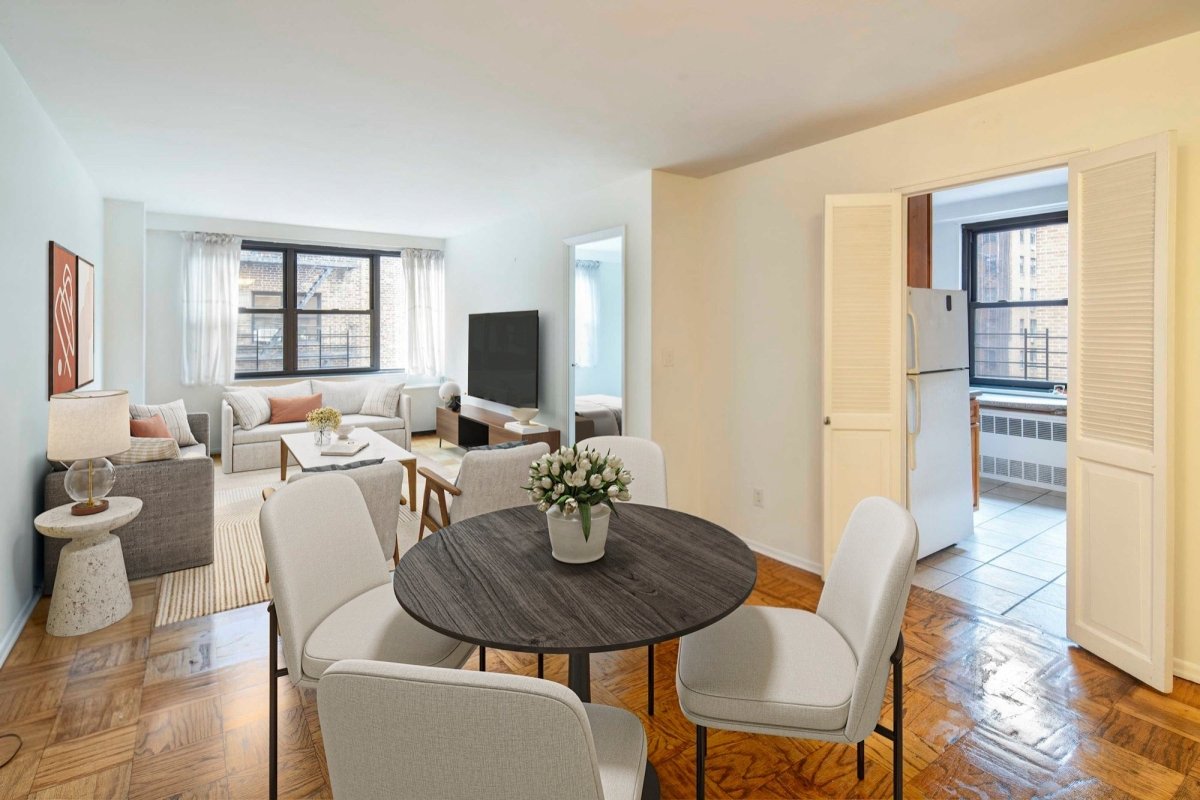
A Bella Virtual case study · Murray Hill, Manhattan · Sold $749,000 · by the Bella Virtual design team
When I first walked through the photos of 305 East 40th Street #11S, I knew this project would hinge on Manhattan condo virtual staging done right — not just filling an empty room with pretty furniture, but solving a real spatial problem. This Murray Hill one-bedroom had a single combined living-dining room that had to do two jobs at once: welcome you home after work and host a dinner party. Empty, it read as one long, ambiguous space with a vintage china cabinet as the only fixed point of reference. My job was to give buyers — busy Manhattan professionals who tour apartments on their lunch break and need to see the floor plan instantly — a clear, livable story in every frame.
View one — establishing the zones
 BEFORE |
 AFTER |
The before photo shows the core challenge: a long rectangular room with a window wall at the far end, a doorway to the bedroom, and that handsome dark wood china cabinet standing guard by the kitchen pass-through. With nothing else in frame, a buyer's eye had nowhere to land and no way to gauge how their own furniture would fit. I split the room into two clear zones. Against the far wall, under the windows, I placed a low-profile gray sofa and a pair of accent chairs around a marble-topped coffee table, anchored by a neutral striped rug that grounds the seating group on the parquet — honoring the client's ask to keep those beautiful floors visible while still defining the space underfoot. A slim wood media console and mounted TV keep the wall functional without crowding the window light. Then, per the brief, I pulled the round dining table forward and set it just off the pass-through, out of the direct sightline into the living zone. Using a round table instead of a long rectangular one here let me keep walking clearance around the kitchen doorway open, which matters enormously to a buyer mentally rehearsing daily traffic patterns in a compact New York layout. The result: one glance and you see 'living room' and 'dining room' as two distinct, comfortable destinations, not one undefined void.
View two — proving the layout works from every angle
 BEFORE |
 AFTER |
This second vantage, shot from the opposite end of the room looking back toward the windows, is where staging really earns its keep for small apartment staging. Empty, this shot is almost disorienting — two bare floor lamps, a long uninterrupted floor, and the same china cabinet cropped at the edge, giving no sense of scale or function. It's the view that makes an apartment feel like a hallway rather than a home. In the staged version, I kept the exact same dining table and chair placement from view one, which reassures a buyer scrolling through listing photos that the furniture story is consistent and the room genuinely is large enough for both zones — no photographic sleight of hand. I layered in artwork on the left wall to break up the long sightline and draw the eye forward in stages, the way it would naturally travel through the room in person. The neutral palette — soft grays, warm blush accents, and bare parquet peeking out at the edges of the rug — keeps the focus on light and proportion rather than on decor choices a buyer would have to mentally 'undo.' This view answers the question every apartment hunter asks when a listing shows a room from two angles: does it actually work as one space? Here, it clearly does.
The takeaway
The lesson from #11S is one I carry into every combined living-dining project: when a room has to perform two functions, don't split it with a barrier — split it with purpose, using scale-appropriate furniture and a grounding rug so the parquet, the light, and the layout all read as intentional rather than accidental. That's the difference between a buyer scrolling past and a buyer picturing their own dinner parties in the space.
Have a Manhattan listing that photographs empty?
Bella Virtual digitally stages homes so they sell faster — no rented furniture, no waiting. See our New York virtual staging →